
Faculty-Led Initiative: aiX Faculty Fellowship Program
The fellowship invites faculty to examine what AI means for their discipline, and develop an AI education project.
The aiX Faculty Fellowship Program is supported as a Faculty-led initiative by the Office of the Vice Provost for Faculty Advancement and led by Dr. Tian Zheng, Professor of Statistics.
Funded by a grant from Google with co-sponsorship from the Data Science Institute and the Center for Teaching and Learning, the aiX Faculty Fellowship Program supports faculty across disciplines to explore and examine what AI means for scholarship and professional practices within their discipline, and to develop an AI education project contextualized within their own discipline.
Grounded in the belief that faculty are the drivers of transformative educational change, this newly-launched initiative seeks to accelerate progress in AI education at scale by empowering faculty to lead innovative, cross-disciplinary efforts by creating space for inquiry, experimentation, and collaboration around AI’s implications for teaching, research, and knowledge creation.
Application Demographics & Expertise
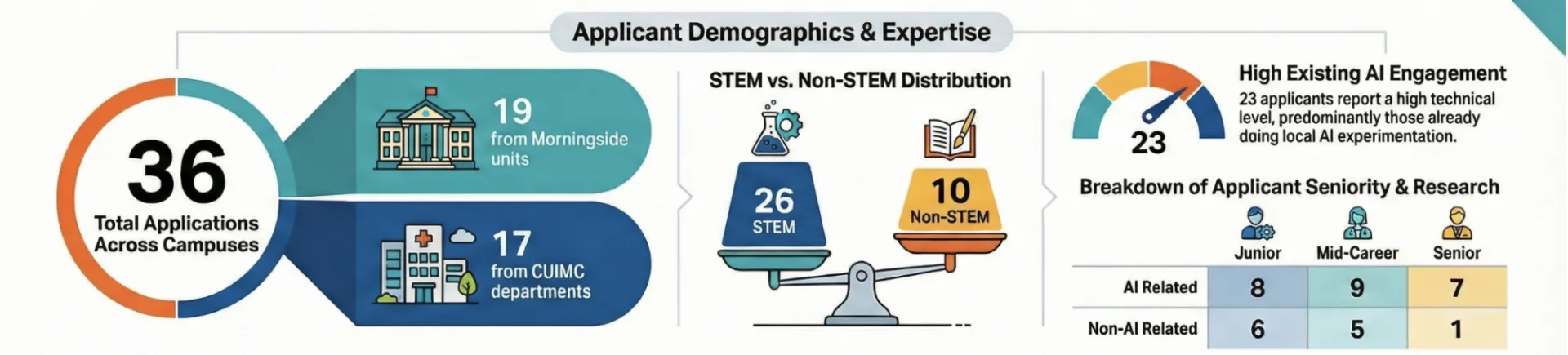
The aiX Faculty Fellowship program received 36 total applications across 12 schools from junior, mid-career, and senior faculty, indicating strong interest among faculty across disciplines. The infographic below shows application demographics from 36 projects.
aiX Faculty Fellows
21 Inaugural Fellows were selected for the program. The main themes for the projects are: AI in Health and Life Sciences, AI in Society, Law, and Governance, AI for Pedagogy and Learning, and Foundational Science and Enterprise. Click here to view the fellows selected and their project details.
Interview with Professor Tian Zheng
1. To start, what first sparked your interest in exploring the role of AI in higher education, and what led you to initiate the aiX Faculty Fellowship Program?
My interest came less from AI as a technology and more from what I was observing in practice—both in my own research and in my teaching. AI was already reshaping how knowledge is produced, analyzed, and communicated, yet our educational structures, from curricula to pedagogy, were lagging behind, struggling to respond in a coherent way. Students were encountering these tools in internships, labs, and industry settings long before faculty had developed frameworks for engaging AI critically and responsibly.
What concerned me was not simply a “skills gap,” but a deeper misalignment between how disciplines used to define expertise and how that expertise is evolving in the real world. Disciplines have always adapted to major methodological shifts (for example, computational biology, neuroscience, climate science, data science). These adaptations historically happen more effectively through faculty-led curricular innovation, when researchers approach education as problem solvers, rather than through mandates or tool adoption alone.
I initially planned to use my sabbatical (2025–2026) to explore what artificial intelligence means for statistical education. But the pace of change in AI was so rapid in summer 2025 that it quickly became overwhelming. It was clear that this was not a problem any one person, or any one discipline, could solve in isolation.
When I spoke with colleagues across other fields, I found that many felt the same uncertainty and urgency. We were all trying to make sense of how AI was reshaping our disciplines, our teaching, and what students need to learn, but there was no shared space to work through these questions together. I realized I did not want to approach this as a solitary project. The aiX Faculty Fellowship emerged from that recognition: the need for a collective, faculty-led space where we could think, experiment, and learn together, rather than navigating this moment alone. I wanted to create a structured but open space where faculty could explore questions such as: What does AI mean for my discipline? What should students genuinely understand before they graduate? And how do we integrate AI in ways that strengthen, rather than dilute, judgment, rigor, and responsibility?
2. How would you describe the aiX Faculty Fellowship Program to someone encountering it for the first time? What makes it distinct from other AI or pedagogy-focused initiatives?
At its core, the aiX Faculty Fellowship is a faculty-led inquiry and design space, not a training program. It supports faculty in experimenting with how AI intersects with their research, teaching, and disciplinary identity, ideally aligned with their own intellectual traditions.
What makes it distinct is that it does not start with a prescribed vision of “AI in the curriculum.” Instead, it starts with faculty questions. Fellows are not asked to adopt specific tools or redesign courses in predetermined ways. They are supported in exploring problems they already care about—research workflows, assessment through assignments, and addressing emerging professional expectations—and then asking how AI might reshape those areas thoughtfully.
The fellowship also emphasizes research–education integration. Teaching becomes a site of inquiry, not just implementation. Faculty work alongside students and peers to prototype ideas, reflect on outcomes, and share lessons learned.
3. The program is grounded in the belief that faculty are the drivers of transformative educational change. Why is faculty leadership so central to this initiative?
Faculty sit at the intersection of research, curriculum, and pedagogy. They are the stewards of disciplinary knowledge, and based on my experiences with data science education, meaningful curricular change has always emerged from faculty grappling with new ideas, methods, and societal demands.
AI raises questions that are fundamentally disciplinary: what counts as expertise, what should be automated versus practiced, and how judgment is cultivated. Those questions cannot be answered by anyone other than the disciplinary experts themselves. They require deep subject-matter understanding, intellectual curiosity and humility, and sustained dialogue and inquiry—precisely the kind of work our faculty do every day.
4. As a statistician, and with the rapid rise of artificial intelligence across disciplines, how do you see statisticians contributing to responsible innovation and guiding the thoughtful integration of AI into research and education? And how does the aiX Faculty Fellowship Program help advance and realize this vision?
Statistics occupies a unique position in the AI ecosystem. Many AI systems are built on statistical foundations, yet their deployment often obscures uncertainty, assumptions, and limits. Statisticians are trained to ask: What does the data actually support? Where does uncertainty matter? And how should evidence guide decisions?
In AI education, these statistical thinking principles are essential. AI can automate tasks, but it cannot replace epistemic judgment. Statisticians, along with other quantitative and methodological scholars, can help reframe AI not as a black box to be used, but as a system to be interrogated, validated, and governed responsibly.
I hope that through the aiX Fellowship, I can identify ways that statistics can support integrating such principles into AI education across disciplines. This program may surface shared concerns about rigor, evaluation, and responsibility that statisticians, humanists, engineers, policy researchers, and experts from many professional disciplines can collectively address through curricular development. In other words, the fellowship is less about spreading AI expertise and more about strengthening our ability to build intellectual guardrails as AI becomes embedded in research and teaching.
5. The program emphasizes inquiry, experimentation, and collaboration. Why was it important to create a space for exploration rather than prescribing a fixed approach to AI education?
AI is evolving too quickly and affects disciplines too differently for a single prescribed model to be effective. More importantly, meaningful educational change requires experimentation. Faculty need room to test ideas, learn from failure, and adapt approaches based on evidence and reflection.
Prescriptive approaches tend to focus on tools or techniques. The aiX Fellowship focuses instead on questions: What should students learn? What practices still matter? Where does AI genuinely add value, and where does it risk eroding learning?
6. What do you hope faculty Fellows achieve as part of the fellowship, and how do you envision it driving the broader conversation around AI, teaching, and research at Columbia University, both in the short and long term?
In the short term, I hope Fellows (myself included) gain clarity and confidence about AI in relation to our own disciplinary work—not mastery of every AI tool, but a grounded understanding of how AI intersects with our disciplinary goals, our educational values, and our students’ futures. I hope the Fellows will carry out concrete experiments, such as course modules, assignments, and research workflows, and that we will become a peer community that continues to learn from one another.
In the long term, I see the fellowship contributing to the broader Columbia community by developing shared templates and models for engaging with AI through a faculty-led, research-informed process. The goal is not to prescribe solutions, but to offer concrete examples of how disciplines can thoughtfully explore AI in ways that align with their intellectual values.
More broadly, I hope the fellowship demonstrates that AI education is not about reacting to technical pressure or chasing tools. In many disciplines, it is a call for faculty to assume intellectual leadership—clarifying what expertise means in the era of AI, guiding how new technologies are used, and preparing students to navigate a changing world with principled judgment and responsibility.
Ultimately, the goal is not to mandate AI into the curriculum, but to ensure that education remains responsive to the world our students are entering, while staying anchored in the university’s core mission: cultivating judgment, expertise, creativity, and responsibility.
Closing Remarks
As Columbia continues to navigate the rapidly evolving landscape of artificial intelligence, the aiX Faculty Fellowship Program exemplifies the University’s commitment to faculty-driven innovation in both research and teaching. By equipping faculty with the resources, collaboration opportunities, and intellectual community needed to explore AI’s disciplinary impact, the program not only enriches the curriculum and scholarship across the University but also lays the groundwork for future interdisciplinary partnerships and pedagogical transformation. Through faculty-led initiatives like aiX, Columbia reaffirms its commitment to advancing faculty through bold, peer-driven programs that foster innovation, knowledge creation, and a vibrant, university-wide community.