
Event Recap: Cultivating Your Network of Mentors, Sponsors, and Collaborators
Online workshop held October 28, 2026
Led by Frank Sesso, NCFDD, and organized by the Office of the Vice Provost for Faculty Advancement
How can faculty cultivate a thriving mentoring network?
On October 28, Frank Sesso, Partnership Success Director at NCFDD, joined faculty from across Columbia to discuss how to reflect on, cultivate, and sustain a network of mentors. As part of this conversation, participants considered definitions of mentorship, confronted possible limiting beliefs that can get in the way of connecting with mentors, and strategized next steps in developing a more holistic network of mentors and sponsors.
Three especially helpful takeaways from this session included:
- Success isn’t just about the work, it’s also about relationships: NCFDD’s mentor map accounts for a range of relationships and supports that can help faculty thrive, including sponsors, intellectual community members, and even friends and family beyond the academy. This network of mentors help faculty meet a range of relational and career needs.
- Mentorship is essential to success at all career stages: Each career chapter or transition a faculty member experiences requires different kinds of support and guidance—and hence, mentorship. Thus, mentoring networks and maps are helpful for faculty at all stages and can (and should) change as faculty advance in their careers.
- When asking someone for support, precision is key. A generic ask like “will you be my mentor” is less likely to meet a specific need than saying something like “I’d love to learn how you won the teaching award” or “Can you share strategies you have used to balance service obligations?” A good starting place is for faculty to think about what they need (to thrive and succeed) and how a specific person can help them work toward that vision.
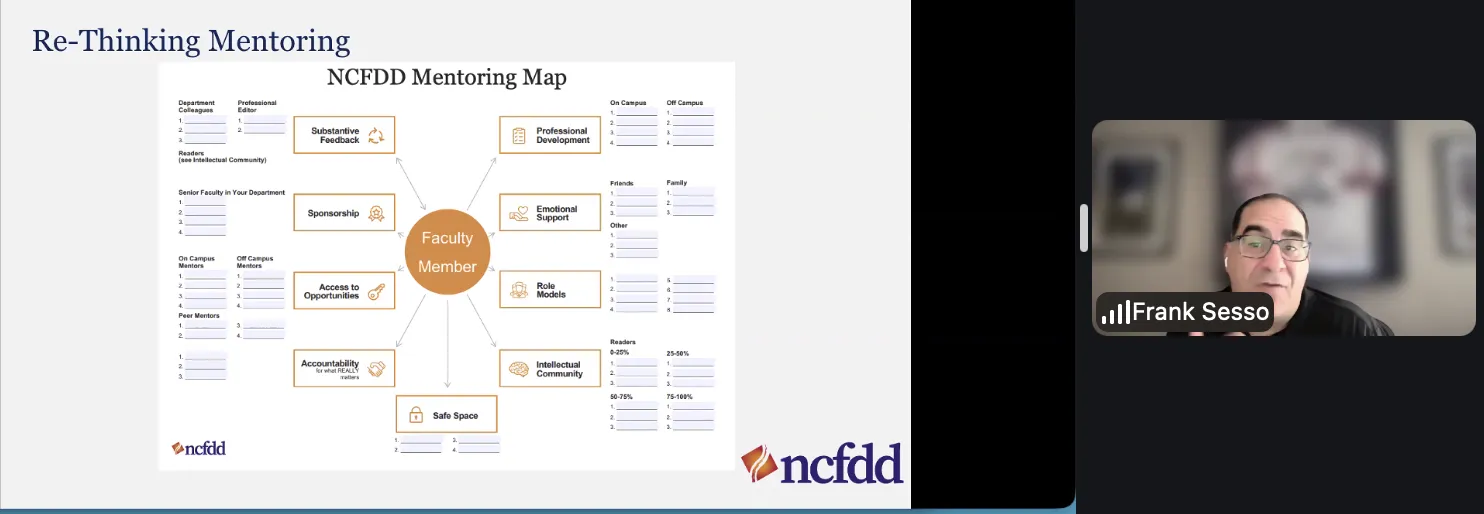
This session was a Columbia-specific version of the NCFDD workshop, “Cultivating Your Network of Mentors, Sponsors, and Collaborators,” which is part of NCFDD’s core curriculum and available on-demand here.* Each aspect of NCFDD’s curriculum aims to help faculty thrive in the academy by building skills and networks for success.
*We invite all members of the Columbia community to learn more about NCFDD, activate a free institutional account, and browse upcoming webinars and on-demand resources by role and theme on our new Institutional Hub.