
Event Recap | Funding Forward: A Conversation with Health Sciences Foundation Leaders and Grant Makers
About the Event
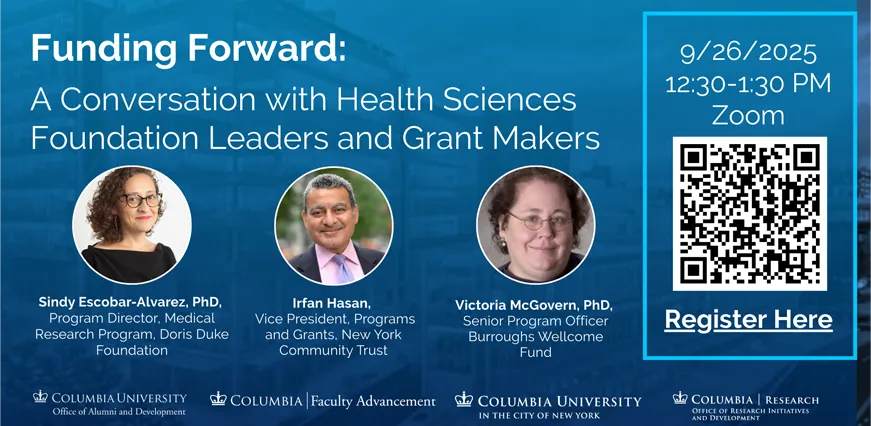
This session discussed how foundations in the health sciences are approaching grantmaking in today’s challenging climate and provided insights into the opportunities and expectations shaping this funding landscape. The conversation explored strategies for building successful approaches and help researchers strengthen their engagement with health-focused foundations. The event was co-hosted by the Office of Research Initiatives and Development and the Office of Alumni and Development.
Resources and Takeaways
- Overview of Participating Foundations
- NY Community Trust (Community Foundation): Supports a wide range of program areas with donor-advised and legacy funds. Grants are often modest but focus on early-career researchers and systemic change.
- Doris Duke Foundation (Private/Family Foundation): Centers grantmaking around “big ideas” that seek systemic change, elevate diverse voices, and open new pathways for innovation.
- Burroughs Wellcome Fund (Independent/Research-focused Foundation): Focuses on underserved scientifi c areas and on developing people, especially early-career scientists. Offers fl exible, high-risk, high-reward funding.
- The New York Community Trust (NYCT)
- Speaker: Irfan Hasan, Vice President, Programs and Grants
- Overview and Approach
- Serves as the community foundation for New York City, Westchester, and Long Island.
- Draws funds from thousands of donor-advised and legacy funds, supporting a broad range of areas including health and biomedical research.
- Operates on a long-term lens, focusing on systemic change rather than individual projects, while supporting research through specific, time-limited projects (typically 1–3 years).
- Grants are modest in size but strategically directed toward early-career researchers, where relatively small investments can have meaningful impact.
- Funding Priorities and Trends
- Biomedical research grants total approximately $600,000 annually, with some donor-directed funds supporting specific diseases such as cancer, Parkinson’s, and heart disease.
- Emphasizes proof-of-concept research that can demonstrate early outcomes and lay groundwork for future funding.
- In the current funding climate, NYCT maintains its commitment to systemic and sustainable change, recognizing limits of scale while leveraging its local focus.
- Proposal Guidance
- Proposals should clearly define achievable outcomes within the short grant period.
- Successful applications explain why the project matters, what results are expected, and how findings could influence larger-scale funding or policy.
- Communicating research value in clear, accessible terms is essential as proposals are reviewed by non-scientist boards.
- Researchers are encouraged to engage early with institutional development offices and understand internal submission processes.
- The Doris Duke Foundation (DDF)
- Speaker: Sindy Escobar-Álvarez, Program Director, Medical Research Program
- Overview and Mission
- A national philanthropic foundation established by Doris Duke to advance a creative, equitable, and sustainable future across multiple domains, including health and well-being, arts and culture, and environment.
- Within the Medical Research Program, grantmaking is guided by “big ideas” that challenge conventional thinking and seek to drive systemic change.
- Funding Approach and Emerging Priorities
- Focuses on bold, idea-driven initiatives rather than isolated research projects.
- Emerging initiatives such as “New Pathways for Health Innovation” aim to support new models of health research and community engagement.
- Promotes equity, sustainability, and inclusion, elevating diverse voices and fostering community-centered innovation.
- Recognizes that while foundations cannot replace shrinking federal funds, they can help fill critical gaps through strategic, collaborative, and time-bound interventions.
- What Makes a Strong Proposal
- Alignment is essential — proposals should clearly reflect the foundation’s mission and current “big ideas.”
- Demonstrate clarity of thought: proposals that are focused, readable, and authentic stand out.
- Avoid reusing NIH-style or recycled applications; tailor content to Doris Duke’s specific goals and review criteria.
- Funders value applicants who are visible in their field and engaged beyond publications — through conferences, panels, or public communication. “We can’t fund you if we can’t find you.”
- Additional Notes
- DDF has an active interest in science communication, supporting journalism fellowships and exploring how institutions can expand communication resources for faculty.
- Acknowledges the growing need for scientists to engage with policy and advocate for science funding and public trust.
- Burroughs Wellcome Fund (BWF)
- Foundation Overview
- Originally the corporate foundation of Burroughs Wellcome Drug Company, now an independent private foundation focused on developing people and advancing underserved scientific areas.
- Prioritizes early-career investigators, offering flexible funding to help them explore new directions and establish research independence.
- Supports both individual development and research community building, aiming to create a “healthy infrastructure” for science.
- Current Context and Funding Climate
- BWF views the current period as an extraordinarily dynamic time in science — with unprecedented computational, biological, and data tools enabling new discovery.
- While funding remains competitive and uncertain, researchers are encouraged to “dare to be excited” and embrace this moment as an opportunity for creative advancement.
- Applications have more than doubled in some programs, reflecting the growing competition and “panic writing” among researchers seeking support.
- Advice for Applicants
- Focus on clarity, originality, and authenticity rather than volume of submissions — reviewers value thoughtful, well-aligned proposals over many scattershot ones.
- Strong candidates are those who demonstrate:
- A clear sense of direction and purpose;
- The ability to articulate what they want to do and why it matters;
- A track record of curiosity and potential for leadership in their field.
- BWF awards serve as a “second dose of rocket fuel” after the startup package — offering freedom to pursue transformative, high-risk ideas.
- Successful applicants often balance scientific rigor with human connection, demonstrating collaboration, mentorship, and visible engagement in their community.
- Additional Insights
- The foundation values science communication, supporting journalism fellowships and media training to help researchers share their work effectively.
- Encourages researchers to be authentic and visible, participating actively in professional and interdisciplinary spaces rather than seeking “secret rooms” of influence.
- Foundation Overview
- Despite today’s challenges, funders emphasized that this is an exciting time for discovery, encouraging researchers to stay bold, visible, and collaborative in pursuing ideas that drive lasting impact.
Speakers

Sindy Escobar-Álvarez, PhD
Program Director, Medical Research Program, The Doris Duke Foundation (DDF)

Irfan Hasan
Vice President, Programs and Grants, New York Community Trust

Victoria McGovern, PhD
Chief Strategy Officer, Gertrude Elion Endowed Program Officer, Burroughs Wellcome Fund (BWF)