
Faculty Profile: Brenda Jones Harden
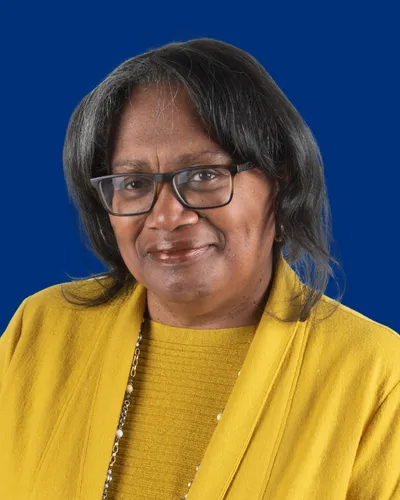
Brenda Jones Harden, Ruth Harris Ottman, Class of '45, Professor of Child and Family Welfare, spoke with us about the Washington, DC community of her youth, her shift from clinical to academic social work, and her decision to join the Columbia faculty.
How did your background and upbringing influence your choice of career?
As social workers or mental health providers, one of the most important things that we do as practitioners is to look inside ourselves. We know that our identities impact not only how we practice, but how the community perceives us. I grew up in a segregated urban area in Washington, DC at a time when most neighborhoods were still majority Black. It's not that way anymore; it's very gentrified. It was composed primarily of African American families from low-income, working middle-class, and upper middle-class backgrounds; a barrage of people who had a lot of socioeconomic diversity, but not any racial diversity. There were hardly any white or Latino families at the time. That gave me the opportunity to be around other African American people who had achieved a lot. All of my teachers were Black. All of my physicians were Black. All of the police were Black.
I wanted to be like the women in my community who had careers and were educated, and who had a commitment to being what used to be called ‘race women’—women who had a clear mission to help others who looked like them. That is an important experience that I had as a young child. On the other hand, I was raised by adolescent parents who didn't have a clue about what they were doing. Fortunately, I had this huge extended family who showed me that just because a nuclear family had some struggles, it didn't mean that you couldn't be embraced by this larger community, which included my great-grandmothers and grandmothers. This was ingrained in me early on.
As a result of that experience, I wanted to work with kids who had more ‘risky’ backgrounds. I wanted to recreate the sense of community to help children who really struggled. I learned about social work from a teacher; I didn't know any social workers. Once I figured out what the field was, I could connect it to the community organizers I knew, who brought food to poor families and tried to get kids to come to school. I ended up graduating from college early because I was eager to get into the field. I was on the streets of New York at the age of 21, working as a social worker. I didn’t have a clue what I was doing, but I did have that fire in me. I wanted to make a contribution.
How did you shift your focus from clinical work in the field to research?
When I went to graduate school, I had every intention of returning to the community-based work that I had spent the first 10 or so years of my career doing. I thought I would run an agency, or work in an applied research firm or a policy think tank. I always knew that I wanted my work to have an impact on kids. Ed Ziegler, my advisor, was one of the architects of Head Start. He asked, “If you go back to clinical work, how many kids are you going to impact? You are going to have a caseload of 20, maybe 40. If you use academia as a platform, you can potentially impact many, many more children.” I had never considered that before. I decided to listen to him—and he hasn't steered me wrong yet.
"I was on the streets of New York at the age of 21, working as a social worker. I didn’t have a clue what I was doing, but I did have that fire in me. I wanted to make a contribution."
He showed me, through his own work, how you can be an advocate as a scholar. You can use the research from the community at large to argue in legislative settings, in community settings, or in service settings, for a certain kind of approach to benefit children. I learned from him, and through my other experiences, that you gain credibility as an academic that you wouldn’t receive by using a moralistic, political, or community approach. In academia, I learned to use knowledge to persuade others, and to disseminate empirical work. With this platform, I could do research, or I could dabble in both policy or practice; it was a beautifully intersectional way of serving kids that kept me excited and interested.
You spoke about the importance of persuasion. How has your ability to be persuasive impacted your work?
My advisor taught me that you have to be in it for the long game. Particularly at the federal level, policy change is very slow. He taught me that being part of a larger movement mattered, and that the movement had to stay consistent. For example, I've been part of this organization called Zero to Three for probably 25 years. I'm the president of the board now. Their mission is to ensure that all babies, particularly from under-resourced backgrounds, have a strong start in life. The data suggest that preventing children's negative outcomes is most effective if you start early in life. I have been part of their policy and advocacy movement for over two decades. With that kind of long-term work, I have seen us as a group of baby advocates across multiple professions, for example, get the funding for Early Head Start increased.
One of the things that I've been preaching to child welfare systems is that you need to have a developmentally sensitive approach. You have to think from a prevention standpoint. I've helped agencies think about how to take a trauma-informed approach, to understand why children are acting out in the classroom, and to engage their parents and give them support so that they do not expose their children to trauma. We help those who are working in early childhood programs take care of themselves, so that they are not reacting to the children's trauma through their own secondary trauma. I have seen programs provide reflective supervision to teachers and other staff, like helping those conducting home visits to understand that their safety and wellness comes first. I have seen organizations really shift their thinking, and then, as a result, shift how they deliver services.
"I've helped agencies think about how to take a trauma-informed approach, to understand why children are acting out in the classroom, and to engage their parents and give them support so that they do not expose their children to trauma."
You came to the Columbia School of Social work at a time when it has had an influx of faculty focused on race and racism, scholarship. How do you hope to fit your work into the curriculum here?
That was very important for me, because I came from a university where there was a lot more diversity than there is here, to be honest. And I really thrive in a diverse environment. For many reasons, not the least of which is that it's important to see people who look like me. It’s what I got as a little kid. The second thing is that I am trying to ‘pay it forward’. I have been helped by a lot of African American scholars who came before me in a lot of places where I was the only one. I was the only black student in my doctoral program for years.
It's really important to me, from a process perspective, to give students and mentees who are coming behind me what I was given by scholars from minoritized backgrounds who came before me. I want to be a part of the infrastructure of support for this new group of faculty. I take that very seriously. It's not in my job description, but it's in my personal job description to really help them get through the academy, because it is very challenging. Not only are we underrepresented in terms of general numbers, but if you start to look at things like retention, for example, it is dismal. We often do not get tenure, and we don't get promoted. I really wanted to help these very smart, very talented young scholars get the validation they deserve, and be able to stay at a place like Columbia. The other thing I'll say is: No, I am not a scholar whose specific focus is race. However, all the families with whom I work are from minoritized backgrounds. So because I focus on these families from risky backgrounds in urban settings, the ones I've been in contact with are 99% African American and Latine. These are the families with whom I've worked and I've devoted my career to.
"It's really important to me, from a process perspective, to give students and mentees who are coming behind me what I was given by scholars from minoritized backgrounds who came before me."
You were in New York at the beginning of your career, and here you are again. What is it like being back? What opportunities does New York offer?
This idea of going full circle really resonated with me psychologically. When I was here before, I was a social worker working for community-based organizations, and you can imagine I wasn't making very much money. I never thought I'd get to live on the Upper West Side, and if it weren't for Columbia's subsidies, I would never be able to live up here. I thought that it would be great to expand on some of the work I did as a young clinician working in these communities from a prevention standpoint.
Now, decades later, I can really try to test out ideas that I didn't have the bandwidth, or the knowledge or the skill to implement back then. I want to focus on the perinatal period a little more, which is not something that I did a lot then. I really want to connect with folks in the medical school and those in the child welfare community who are working with new parents who are contending with severe life challenges. I hope to bring some funding and my skills to some of these community-based agencies, and really work collaboratively. I’m looking forward to identifying the agencies and funding sources that might be willing to work with me to do this.
Is there anything else that you would like to add?
I just want to go back to this issue of being part of the cluster hire, to which I'm kind of adjacent. I think it's important to acknowledge that the students who come here need to see that there are senior scholars who look like me, who can be their teachers. But I also think it's important for the New York community to see that there are scholars from Columbia who are taking on these issues like child welfare, who also look like me, because they are used to seeing somebody who looks different from them. I think it's important for Columbia to be able to say to the community that we can recruit people who are from different and diverse backgrounds, and that they can be just as credible as anyone else.